
Small Bedroom Ideas: How to Make Any Bedroom Feel Bigger

Small Bedroom Ideas: How to Make Any Bedroom Feel Bigger
A small bedroom doesn't need to feel small. The difference between a room that feels cramped and one that feels considered usually comes down to a handful of decisions: the size of the bed relative to the room, how much floor space is visible, how the light is handled, and how much is on the surfaces. None of those requires structural changes or a full redecoration.
Here are eight practical ideas that make a genuine difference, starting with the one that matters most.
1. Start with the right bed size, not the biggest one that fits
The single most common mistake in a small bedroom is buying the largest bed that physically fits the room. A king-size bed in a room that's 3.5 metres wide will take up most of the floor and leave barely enough space to walk around it. The room ends up feeling like it exists to contain the bed rather than the other way around.
The right bed size for a small bedroom is the one that leaves enough clearance on the sides and foot to move comfortably. The standard recommendation is 70cm of clearance on each accessible side and at least 90cm at the foot. Work those measurements out before choosing a bed size, not after.
For a single occupant in a smaller room, a double rather than a king often makes the room feel significantly more liveable without any meaningful loss of sleeping comfort. For a couple in a modest double bedroom, a king can work if the room is at least 3.5 metres in one dimension, but a standard double (135cm wide by 190cm long) gives considerably more breathing room and rarely compromises actual sleep quality.
Swyft's double beds and single beds are delivered in flat-pack boxes that are guaranteed to fit through any doorway, which is particularly relevant for smaller rooms that are often harder to access with bulky furniture.

2. Storage beds do the work of furniture you don't need to buy
A small bedroom typically has limited space for a wardrobe, a chest of drawers, and all the other storage furniture a bedroom needs. The usual solution is to stack more furniture into the room, which makes it feel more crowded. A storage bed solves the problem differently: it consolidates the storage into the piece of furniture that's already taking up the most floor space.
Ottoman storage beds open from the top to reveal a large compartment beneath the mattress, typically deep enough for bedding, seasonal clothing, luggage, or anything else that doesn't need frequent access. The storage is completely hidden when the bed is made, which means the room doesn't look like a storage space even when it's being used as one.
The practical calculation is straightforward. A storage bed replaces at least one chest of drawers, freeing up a meaningful section of floor or wall space that can remain clear. In a small bedroom where every square metre matters, that trade-off is usually worth making even if the storage bed costs slightly more than a standard frame.
Swyft's storage beds are ottoman style, available in double, king, and super king sizes, and pair with the wider bedroom furniture range if additional storage is still needed.
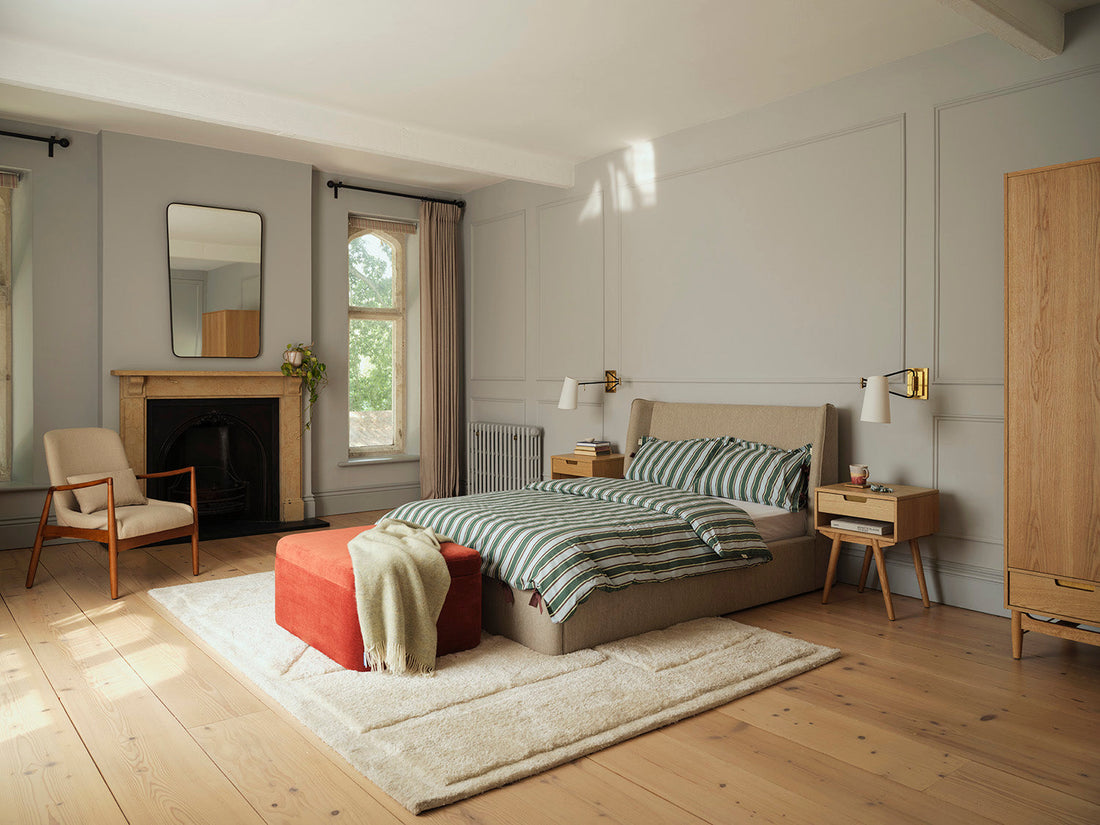
3. Raised legs on furniture keep the floor visible and the room feeling open
Furniture that sits directly on the floor, with no gap between the base and the ground, creates a visual barrier at floor level. The eye reads the room as a series of solid blocks and the floor seems to disappear between them. Furniture on raised legs does the opposite: it lets light pass underneath, keeps the floor visible, and makes the room feel less crowded even when the same amount of furniture is present.
This applies to beds, bedside tables, and any other freestanding pieces in the room. A bed on legs, even short ones, reads as lighter than a divan base that sits flush to the floor. A bedside table on slim legs takes up less visual space than a solid cabinet of the same dimensions.
Swyft's upholstered beds sit on raised legs as standard, which is one of the reasons they tend to work well in smaller rooms. The bedside tables follow the same principle: slim, raised, and designed not to crowd the floor space around the bed.
The effect is most pronounced in rooms with good natural light, where the gap under the furniture reflects light across the floor and adds to the sense of space. In darker rooms, a warm lamp on the bedside table achieves something similar by drawing light down to floor level.

4. Light colours work, but tone-on-tone works better
The advice to use light colours in a small bedroom is standard and broadly correct. Light walls reflect more light and make a room feel more open than dark ones. What most people don't know is that the next level up from light colours is tone-on-tone: using the same colour or closely related tones across the walls, bedding, and soft furnishings.
The reason it works is that the eye reads tonal consistency as spaciousness. When everything is a similar tone, the boundaries between surfaces become less defined and the room feels less segmented. A white wall next to a bright bedspread in a contrasting colour defines a hard edge; the same wall with bedding in a similar tone blurs it. The room doesn't look smaller, it looks more considered and more open.
In practice, tone-on-tone doesn't mean the room has to be monochrome or boring. Texture becomes the point of interest rather than colour contrast: a linen headboard against a warm white wall, a slightly deeper cushion against a lighter throw. Swyft's upholstered beds come in a range of fabric options across both velvet and linen, and ordering free swatches before committing is the most reliable way to check how a fabric tone reads in the actual light of the room.

5. Mirrors: placement matters more than size
Mirrors make a small bedroom feel larger by reflecting light and creating the impression of depth. This is well-established and genuinely works, but the placement makes a bigger difference than the size of the mirror.
The most effective position for a mirror in a small bedroom is opposite or adjacent to a window. This reflects natural light back into the room rather than just showing a reflection of a wall. A mirror that reflects a window effectively doubles the apparent light source; one that reflects a dark wall adds nothing.
A full-length mirror leant against a wall rather than hung adds a casual, considered quality and works particularly well in bedrooms with limited hanging space. On a narrow wall or in an alcove, a large leant mirror fills the space without requiring fixings and can be moved easily if the layout changes.
Mirrored wardrobe doors are a practical solution for smaller bedrooms because they serve two functions simultaneously: storage and the light-reflecting effect of a large mirror. The full-length reflection also makes getting dressed easier without requiring a separate standing mirror.
For more on how to use mirrors effectively in a small bedroom, see clever ideas to make your bedroom look bigger using mirrors.
6. Vertical space is almost always underused
Small bedrooms tend to be treated as two-dimensional problems: floor space is managed carefully, but the walls above shoulder height are often left completely empty. Using vertical space effectively changes the proportion of a room, draws the eye upward, and creates the impression of height.
Shelving that runs from mid-wall to ceiling height adds storage without taking up any floor space. In a small bedroom where floor space is at a premium, wall-mounted shelves above the bedside tables or on a narrow wall between a door and a window are often the most useful addition a room can have.
Curtains hung from ceiling height rather than from just above the window frame are one of the simplest vertical tricks available. Floor-to-ceiling curtains make the window look taller, the ceiling feel higher, and the room feel more generous. They cost nothing extra if you're buying curtains anyway and require only a higher fixing point.
Tall, narrow furniture serves the same function as shelving: it draws the eye up and makes the room feel taller. A wardrobe that reaches the ceiling looks more deliberate and creates less visual noise than one that ends at an arbitrary mid-wall height with empty space above it.
7. One bedside table instead of two
The symmetrical bedside table arrangement, one on each side of the bed, is the default bedroom layout for good reason. It works, it's balanced, and most people don't question it. In a very small bedroom, though, two bedside tables can take up more floor space than the room comfortably allows, particularly on the wall side of the bed where access is already limited.
A single bedside table on the accessible side of the bed frees up a meaningful amount of floor space and often looks more considered than two competing pieces. The alternative to a second table on the wall side is a wall-mounted shelf or a wall-mounted light, which provides the same function (a surface for a glass of water, a place for a lamp) without the floor footprint.
This is a small change with a disproportionate visual impact in a tight room. The floor space freed on one side of the bed makes the room feel wider and easier to move around, and the asymmetry, when executed deliberately, looks intentional rather than incomplete.
Swyft's bedside tables are designed to sit at the right height alongside the Swyft bed range. Buying one rather than two is a straightforward edit that most people don't consider.
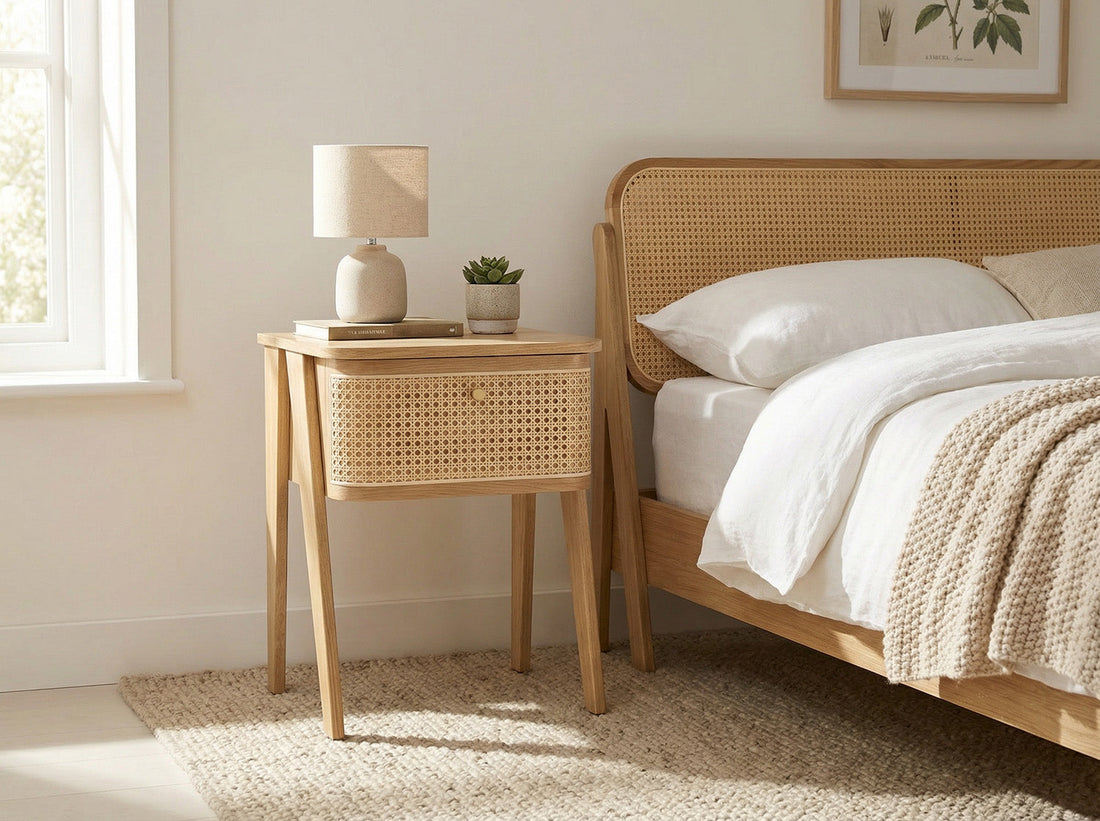
8. Edit the bed dressing: less reads as more space
A bed piled with cushions, bolsters, and multiple throws in contrasting colours fills the room visually in a way that's easy to underestimate. The bed is already the largest surface in the room; adding volume and pattern to it makes it read as even larger.
A cleaner bed dressing, fewer cushions, a single throw rather than several, bedding in a tone that relates to the walls rather than contrasting with them, makes the room feel calmer and more open. This doesn't require anything to be removed permanently; it's a styling decision that costs nothing and has an immediate effect.
The practical guide: two to four cushions maximum on a double bed, arranged neatly rather than piled; one throw rather than layered blankets; pillowcases and bedding in a cohesive tonal range. Swyft's cushion collection and throws include options across a range of tones specifically suited to a considered, unfussy bedroom arrangement.
The goal isn't a bed that looks unlived-in. It's a bed that looks finished rather than accumulated. In a small bedroom, the distinction between the two is where a lot of the work gets done.

Bedroom furniture for smaller rooms
The collections most relevant to making a small bedroom work harder:
- Storage beds: ottoman beds that consolidate storage into the bed itself
- Double beds: properly scaled for smaller rooms without compromising on comfort
- Single beds: the right choice for a solo sleeper or a genuinely compact space
- Bedside tables: slim, raised profile designed not to crowd the floor
- Bedroom furniture: the full bedroom range, designed to work together


